
Innocence
Losing and rediscovering the birthright of humanity

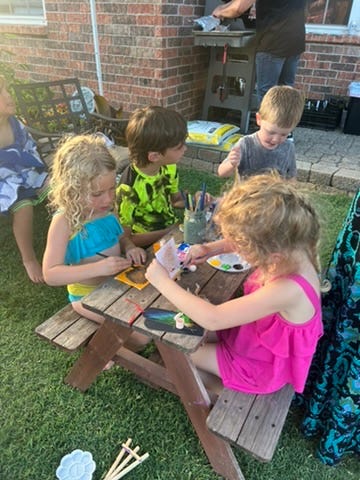
I’ve stopped writing for a couple of weeks, with a feeling of emptiness recently that has seemed unexplainable. It hasn’t been the kind of emptiness that comes from loneliness, lack of purpose, or loss. In fact, my life has been very full of love and celebration as I turned 50 last weekend. I celebrated with a birthday party that my younger self would have given anything to have. I invited several of my friends to come with their families - children of all ages - and we set up activities around the house and yard for splashing, painting, and picking flowers from my abundant garden. Watching the faces of all the children as they created works of art on canvas, wandered among the zinnias and daisies selecting the best ones for their bouquet, and ran carefree through fountains of water with a hotdog in one hand and a cupcake in the other was the best birthday gift I could have ever given myself.
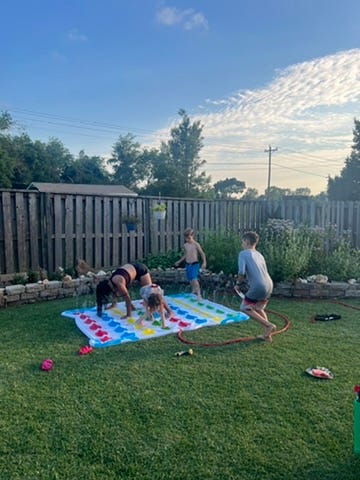
I decided to celebrate myself at age 50 with a celebration of my own inner child and my love of the innocence of childhood.
For the last few weeks, I have picked up my journal or sat at my computer with the intention to write, but nothing showed up, nothing was ready to come out. It felt like my usual process of reflection and insight had stopped its flow, and I simply didn’t know what I had to say.
Come with me while we go on a journey through my inner world. We’re going to do a bit of time travel and quantum jumping today, so I hope you enjoy the ride.
It’s been messy in here for a long time. Several years ago I realized that I had some healing to do, but I wasn’t sure where I was going to go, or what I would learn along the way, or who I would be “after” the healing. My internal mess was comfortable for me, as it was full of rationalizations, coping mechanisms, fears, and attachments that had allowed me to survive many challenges in life. But it was also disorganized, as thoughts and behaviors were shuffled from one pile or situation to another in an effort to feel in control of my outer circumstances. I certainly didn’t have the awareness or the language to describe my neurodivergence, ADHD-related behaviors, people-pleasing, issues with trust and attachment, self-defeating thoughts, and crippling perfectionism.
Through my lifetime as a musician - violinist from age 5 - I have processed many of these things through the journey of teaching. My early years as a violinist were not what I would call a happy pursuit of the love of music. More often, I took every correction to heart, felt emotionally overwhelmed, and frequently experienced punishment for my emotions. Many in my generation can relate to being told to “stop crying”. There was pressure to perform, to get it “right”, and to control my emotions. My mother did not have the tools when she raised me to hold space for my emotions while also regulating her own emotions, so our relationship was full of conflict. I learned that my achievements were the source of my self-worth (toxic), that I should control and suppress my emotions (toxic), and that I could not trust my body or inner senses (also toxic).
I entered adulthood with marriage at a young age and had four children by age 28. I will be the first to admit that I didn’t have many more tools or awareness in my parenting to do a much better job for my children. But like life always does, life brought experiences that became the school and the medicine I needed to learn and heal. I had been teaching violin to private students since high school, but as a young mother, I found myself teaching full-time when I went through my first divorce in 2005 as my husband came out as gay. Everything I had believed my life was crumbled in an instant, leaving me heartbroken and confused. But every week, 40-ish students and their parents came into my home studio for guidance in learning their instrument. I became very skilled in putting on my teacher “mask” and doing my best teaching, then closing the door at the end of the day and being less-than-present with my children.
I was keenly aware that my marriage had failed, and I didn’t waste any time in my search for a new husband. I coped with the pain of my divorce by working out, losing weight, and engaging online with single or divorced Mormon men, usually long-distance. I was also deeply invested by that time in my professional training and performing experience, gaining more credentials and playing with professional symphonies. Between the attention I was getting from men with romantic potential and the applause I would receive at the end of performances, all of my self-worth was wrapped up in how I could be seen as desirable, attractive, talented, successful, hard-working, and accomplished. What I carried under that exterior was inherently self-loathing and self-critical. I could never look in the mirror and like what I saw. The incoherence between my outer self and inner pain was a reality I began living with every day, unaware that it could change, unconvinced that I would ever want to change.
I did get married again, and was divorced six months later. My third attempt at marriage didn’t come as easily, as I was severely burned by the experience of jumping in with both feet without giving myself any time to grow or heal. It was not only the marriage but all the dating, before and after, that continuously battered my ability to trust. I did eventually marry a Mormon man for a third time, setting in motion life-altering events for me and my children that would plunge us all into the most difficult times yet. The dynamics of stepfamilies and an emotionally-abusive marriage, moving to a new town, losing the physical closeness and support of family, and a long process of leaving that abusive marriage after multiple attempts brought me to a breaking point in my life. By this time my children were ages 11-19, beginning to leave home and begin their own adult lives. At the same time, their dad moved into the same town where we lived, after a seven-year absence in our lives.
I could write a book about our experiences. Maybe a lot of books. But right now I need to just sum it up: we did a lot of things, many of them were very hard. The greatest casualty of all these things was the loss of our INNOCENCE.
What do I mean by INNOCENCE?
(This is the part of this article that has been beating on my brain and heart to come out for the last few days.)
It’s not the first thing I think when I think about innocence, but to understand it, I realize that the opposite of innocence is GUILT. To say that a person is innocent before being proven guilty is a paradigm that really got flipped in the process of my internal wounding. The intense focus on being right and doing the “right” thing from my childhood through my parents, through church, and through school created the imposition of guilt on me. I was not given the benefit of belief in my innocence. I was assumed guilty and had to prove with intensity my innocent intent.
But going back even further, into a time before my memory is clear, I know there must have been a version of me that existed before I was guilty. It’s impossible for most people to look at a newborn baby and not see complete innocence in their newness. Unspoiled, pure, fragile, innocent. Surely I was an innocent baby.
Then I was a precocious toddler. Then I became a big sister. One story that has been told in my family for years was about a time I threw a tantrum, screaming out of control, probably about 3 years old, and my parents put me outside on the porch and told me I could come back in when I stopped crying. This is not something I have in my own memory, but the story has been repeated so many times that I can relate it to all the times I’ve had to shut down my feelings to be acceptable to others. My feelings made me guilty, and I would not be included where I expressed my feelings. The story reinforced that my ability to suppress my feelings would make me acceptable and worthy in my family.
One of my first clear childhood memories was shortly after my 4th birthday. I remember taking a dinner roll from the bread drawer, probably because I was hungry or liked bread (what other motive could a 4-year-old have?). My mom saw me and asked me if I took a roll from the drawer, even though I’m sure she could see that I was hiding it behind my back. I guess I took a chance, and I said “no”. The first lie I ever told, in my own memory. Her response was, “I guess now that you’re 4 years old, you can’t be a good girl anymore.” Guilty.
Now the fact is that nobody retains the innocence of a newborn, and we’re not meant to. We gain experience, we learn lessons, we make mistakes, we suffer pain, and we cause suffering to others. It is the nature of being human that we go from a state of innocence, or so we believe, to a fallen state of being guilty, ashamed, and separated from our source of love, truth, and wisdom.
I think my first loss of innocence came from being declared guilty by my mother. For most, our first sense that we are guilty does come from the judgment of our parents or others. Because someone imposes a verdict of “wrong” on something we did without intent, we begin to see ourselves as a collection of “rights” and “wrongs”, and depending on other conditioning, we may believe that we’re flawed, or in my case, we will mask our normal tendencies and overachieve in an effort to be “right”.
A second loss of innocence emerged as I reached school age and became immersed in the influence of “others”. Classmates, teachers, bus drivers - there was a new dialogue around me. And while I was labeled “gifted”, I was also naive to many things that it seemed other kids knew. I had never listened to rock music, as my parents had not allowed it in the house. I didn’t have the name brand clothes or the trendy toys that my friends had. I was a bookworm, a nerdy intellectual who longed to be included with the popular kids. As I became aware of how different I was, I felt that being naive and innocent was a bad thing. I was a late bloomer, physically, and remember girls who were developing boobs making fun of me for being a “pancake”. The only thing I knew about bodies and sexuality was that they were so bad that we didn’t talk about them at home. I finally looked up “Sex” in the World Book Encyclopedia when I was 10 years old, knowing that I didn’t know anything, and I could not stand being so naive.
We never talked about anything related to sex in the home where I grew up, as if somehow by never talking about it, my parents could protect the innocence of their daughters. But my curiosity and my desire to fit in with my peers caused me to figure out a lot of what I didn’t know. I remember reading, “Dear God, It’s Me, Margaret” at a time that I didn’t know how much I longed to be seen as a mature girl with needs and awareness and acceptance. I relinquished the innocence of being a child in order to begin growing up. I listened to rock music secretly in my bedroom. I checked out all the books in the “Sweet Valley High” series and read about the way high school girls and boys talked and flirted and made out and all I wanted to do was to like a boy who liked me and wanted to make out with me. But at the same time I felt soooo guilty and ashamed, because any time I had liked a boy I was shamed and made fun of by my parents. I had learned to hide my interest in boys, and had still never kissed a boy by the time I was 15.
I HAVE TO WRITE ABOUT THE ASTROLOGY - SATURN.
This is a complex archetype, but arguably one of the most important cycles we experience as humans. Saturn is the planet of what makes life difficult and possible. It’s the challenges we face, the obstacles, limitations, rules, structures, and institutions. It’s the process of aging and maturing and ultimately dying. It’s the physical experience, the incarnation into physical bodies subject to hunger, fatigue, emotions, threats, survival, and change. It’s our learning, the wisdom that develops over time, the hard lessons that become our greatest teachers. It’s the patriarchy, the systems of control and authority, the judgment we give or receive, the standards of good/bad, right/wrong, dark/light that define, label, and place us into boxes where we may or may not believe we belong. We feel the Saturn qualities of being human when we experience shame, guilt, criticism, isolation, depression, loneliness, and fear. Saturn is our Karma, the consequences of everything in our past coming to pass in our now.
Saturn completes its journey around the Sun every 28-29 years. From it’s position at the time of your birth, Saturn moves 90° every 7 years, forming a square or opposition aspect to that natal placement. Squares and oppositions in the Saturn cycle mark significant points in our development, and in my story, one of the Saturn archetypes that manifested during these key points was that of judgment - innocence versus guilt, innocence versus gaining knowledge, and innocence versus shame.
As dark as Saturn transits can feel, the archetype includes the light and the shadow. There is much to be gained through Saturnian lessons and experiences. As we overcome the difficulties of life, we develop resilience, empathy, and compassion. We become more discerning, we gain wisdom, and we learn self-control. We experience healing of the very wounds that Saturn allowed us to inherit. It has been easy to reflect on my 50 years of life and see how many of these qualities have been learned and earned, but as I close in on my last Saturn square before my 2nd Saturn return, a new element of the Saturn archetype has appeared that I was not expecting. It has emerged as a result of years of deep inner work and healing (therapy, mindfulness, meditation, and other modalities), and to my surprise, as a continued part in my healing, I am returning to a state of INNOCENCE.
Let me emphasize that this is not accidental, as unexpected as this discovery has seemed. And this has not been an easy process, either.
As we step away from the Astrology, we go back into my current life as I turn 50 years old. Someone asked if I felt different now that I’m 50, and while it’s true that I don’t feel any different than I felt a week ago, there is a gravity to being 50 that I resisted for much of my 40’s. Approaching 50 felt like climbing a mountain, and 50 was supposed to be the peak. But here I am, and there’s more mountain to climb. I may have summited a few hills, but the mountain still looms ahead.
It’s a good thing I’ve learned to like climbing.
Over the last few months in my teaching, I’ve been developing a new concept in how we use the language around skill development. This has felt like a radical shift in thinking, but goes beyond a basic understanding to the HOW of implementation and also includes acknowledging WHY this matters. Here is a simple basis for what’s changing and happening:
We used to talk about correct practice, goals, repetition, and mastery. While this sounds good, it is always necessary to point out the difference between “right” and “wrong” while practicing and teaching in order to make “progress”.
Now, we are no longer using language or intention around being correct or right, even if we have “mistakes” in playing. We now say: nothing can be right or wrong, nothing is a mistake.
What we ARE doing is talking about AWARENESS first. Before we can ever expect a child (or a parent, or ourselves) to begin being capable of a skill, they must first become aware of what the skill is - how it feels in their body, how it looks, how it sounds. Learning is simply a path of moving from less awareness to more awareness.
Once we have established awareness of a simple action (a new bow movement, a new finger pattern, a new rhythm, etc.), then we do it and notice how much ENERGY is required to do the action. On a scale of 1-10, an action which requires full concentration, focus, and attention may require an energy output of 10, while an easy skill (like playing Twinkle) takes no effort and only requires a 1 or 2.
Each time we perform the action, we notice the ENERGY, and if it has changed. (Notice we do not talk about whether it was correct.)
And that is all.
This is the first time I am publicly sharing this new model of teaching. Some might recognize that it is partly based in the growth versus fixed mindset that Carol Dweck wrote about in her book, Mindset. But I have noticed that truly moving into a growth mindset with teaching is a supreme challenge for many teachers (myself included), and while we may feel that we have a growth mindset, there are many patterns in the language, standards, and expectations of our teaching that are still used without an awareness or acknowledgment of the harm they continue to inflict. We may not be berating student for mistakes and undermining their confidence, but we have failed to give them (and ourselves) a way to see music as an expression of the self that is truly an art form. The structure, consistency, and rigidity of practice leaves little room for listening to a child’s emotions, ideas, creativity, and sensitivity. Corrections to notes, rhythms, and bowing add up to anxiety, perfectionism, and low motivation.
Any teacher that desires to try a different approach like this one will have a lot of self-reflection to do. One question I asked my students as I began exploring this new approach was, “How would you feel if you never had to be wrong again?” Of course, they overwhelmingly responded that they would love that, it would be amazing, yes, that would be the best! My next question to them flipped the script: “In exchange for never being wrong, could you be okay with never being right?” While the students had their responses, the bigger response came from the parents as I asked that question. The thought of never being right was almost incomprehensible. Everything that has contributed to our conditioning and our belief of who we are and what makes us good has been based on getting it right. Getting the right answers in school, going to the right college, marrying the right person, getting the right job, buying the right house, going to the right church, and doing all the right things and avoiding all of the wrong things.
Take it into meditation, this question of whether you really need to be right or wrong. We have different generational attachments to being right which stem from different types of generational traumas in our lineage. This is one of the manifestations of karma, as we constantly try to settle the score in our favor, but may not be aware of how much harm has been done for generations in an effort to be right. Organized religion, educational institutions, and politics feed the narrative of how to be right and how to hate what is wrong. It doesn’t matter what side you’re on, there is an orientation we adopt in which we cling to the belief that we are right and that we must separate from and resist that which is different, or wrong. Yet this is the narrative that has led to every war in history, to oppression, slavery, discrimination, hatred, social castes, persecution, genocide. On a personal level, it divides families, friendships, and communities as we seek to make sense of our experience with our current paradigm of “right versus wrong”. It requires one person to blame another for being wrong, for doing wrong, regardless of their awareness or intent. It keeps us from acknowledging that we perceive our outer world through our inner projections. Our intense fear of being wrong projects outward, asking us to see others as more wrong.
So what would happen if we stripped ourselves of our need to be right, so that we could never again be wrong? What is left at the center of our being, without the duality of judgment?
We reach this awareness through experiences that show us a perspective that is different from ours. We meet someone who was raised in a different home environment, a different religion, a different culture - someone from an older or a younger generation - and the interactions we have show us another way to look at the thing we once believed.
And it turns out that the more perspectives we can gain, the more ways we can look at the same thing - the more INNOCENT we become.
The more we can understand another person’s point of view, the more we develop the empathy and compassion that relieves judgment and fear.
The more attachments we release to things that feel secure, controlled, or predictable, the more we are free to engage with ideas and creativity and spontaneous moments of joy and discovery.
Sometimes I look at my life, which is still a real life, with so much wonder and joy and discovery that I feel like a little child again. I invited children and the inner children of my adult friends to a birthday party that celebrated joy and play and the freedom of innocence. It can be a fleeting feeling when you return to mortgages and student loans, politics and media, and conflict in relationships and work and hierarchies and suffering in the world around us. Some days, I naively think that everyone must be doing the same kind of inner work I so deeply believe in, making the same discoveries about how to live more joyfully, how to experience more self-love, how to thrive in creativity, and how to welcome in the abundance of the life force.
But then I teach another lesson and I’m aware that the sensitive child standing before me is still burdened with the same perfectionism and self-criticism their parents are projecting, and I know that we are all on different parts of our path to awareness. So for that child, in that moment, I do the best I can with the words, “There is no right or wrong in this space. There is AWARENESS, and there is ENERGY, and that is all.”
Please subscribe to stay in touch with new things on my horizon. I will soon be offering my services as a Strategy and Vision Coach, utilizing my background and expertise in education and the arts, organizational psychology, astrology, human design, energy work, meditation, and several other modalities to assist others in living their best lives.
If you are interested in discussing my new approach to teaching children, please send me a message or comment below. I am committed to exploring this and trying out new ideas as they come, but I am really interested in a collaborative approach and feedback as I develop this into a usable tool for teachers in the arts as well as the classroom.
If you are interested in scheduling a free 30-minute call to see if my Coaching or Astrology services are a fit for you, or to find out how a coach can help you develop your strategies and vision in your own life, please use the link below to schedule a time. I look forward to expanding my lifetime of teaching children into a coaching practice that encompasses the whole journey of life!